Speak with a licensed insurance agent

1-833-641-4938

TTY user 711 Mon-Fri : 8am-9pm EST

Best 2027 Medicare Advantage Plans: Top Carriers Compared

Reviewed by Russell Noga, Licensed Medicare Insurance Broker (all 50 states) — Last updated August 16, 2026

Most “best plans” lists rank carriers and stop there. That’s the easy half. The best 2027 Medicare Advantage plans are the ones that cover your doctors, carry your prescriptions at a low tier, and cap your downside — and that combination changes county by county.

This page does both halves. It ranks the major carriers on what each actually does well, then shows you the arithmetic that decides whether a highly-rated plan is the best plan for you. Every figure here is finalized CMS data, not a projection.

For the broader overview, see our 2027 Medicare Advantage plans guide.

Already know what you need? Compare 2027 Medicare Advantage plans by ZIP code to see real options in your county.

What Makes a Plan ``Best`` in 2027?

Four things separate a genuinely good plan from one that just looks good on a comparison chart:

  • Your doctors are in it. The highest-rated plan in America is worthless to you if your cardiologist is out of network.
  • Your drugs sit on low tiers. With the 2027 out-of-pocket cap at $2,400, formulary placement drives more of your spend than the premium does.
  • The out-of-pocket maximum is low. This is your protection in a bad health year, and plans in the same county can differ by thousands.
  • The star rating is holding. Ratings fund the extras. A plan sliding downward has less room to pay for benefits next year.

Carrier reputation is a starting filter, not an answer. Use the rankings below to narrow the field, then run the four checks against the specific plans offered where you live.

Compare plans and enroll online

What's Confirmed for 2027 — and What Isn't

There’s a meaningful difference between the two, and most “best of” articles blur it.

Confirmed: CMS finalized the CY 2027 Medicare Advantage and Part D rule on April 2, 2026, along with the 2027 Part D standard benefit parameters. The out-of-pocket drug cap, the standard deductible, the elimination of the coverage gap, and the star ratings methodology changes are all locked in.

Not confirmed: Individual plan premiums, county-level availability, specific supplemental benefits, and 2027 star ratings. Those go public when the Annual Enrollment Period opens on October 15, 2026.

Any article naming specific 2027 premiums or benefits right now is guessing. Treat a 2027 dental, vision, or OTC allowance as unconfirmed until it appears in that plan’s official Summary of Benefits.

The 2027 Part D Changes That Hit Every Plan

Part D Parameter 2026 2027 Change
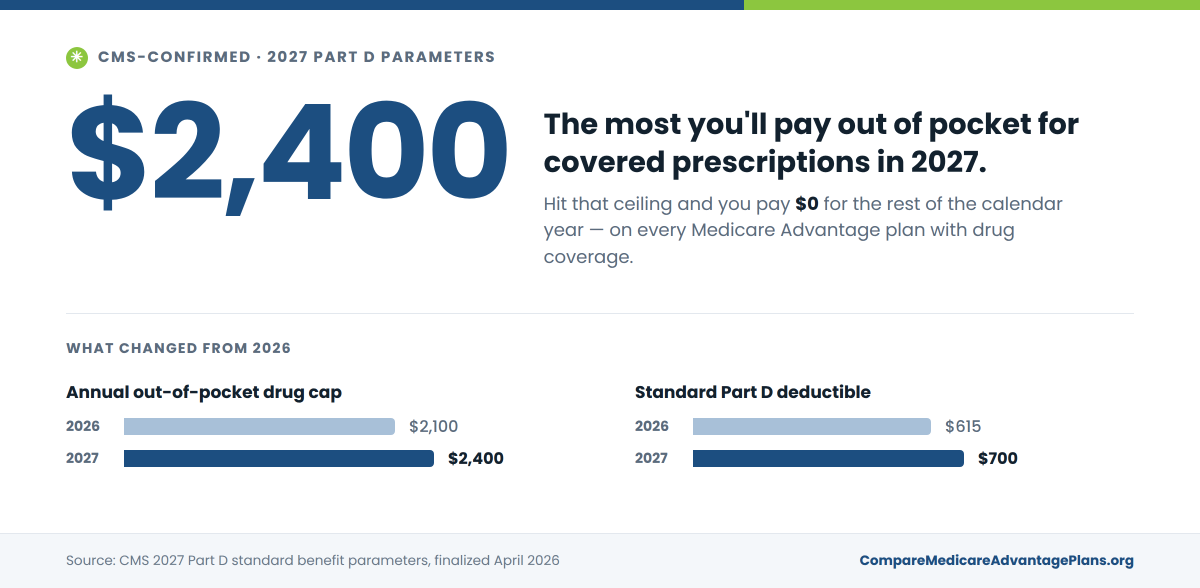
Annual out-of-pocket cap $2,100 $2,400 +$300
Standard deductible $615 $700 +$85
Coverage gap (“donut hole”) Eliminated Eliminated No change
Catastrophic phase cost sharing $0 $0 No change

What the Best 2027 Plans Actually Cost

Medicare Part D 2027 cap

Five numbers decide your total. Premium is the one every list leads with and the one that matters least:

Your Part B premium. Payable no matter which plan you pick, or whether you pick one at all. Some plans offer a Part B giveback — that’s a plan feature, not a rule.

The plan premium. Frequently $0. That doesn’t make it a cheap plan — it means the carrier is paid by Medicare instead of by you.

Copays and coinsurance. Per visit, per specialist, per hospital stay. The spread between two plans in one county can be dramatic.

The medical out-of-pocket maximum. Every Medicare Advantage plan caps in-network medical spending. This is the single most important number on a plan you’d call “best.”

Drug costs up to the $2,400 cap. Driven by formulary tier, not premium. One drug moving from tier 2 to tier 4 can swing your year by thousands.

Medicare Advantage plans cost for 2027

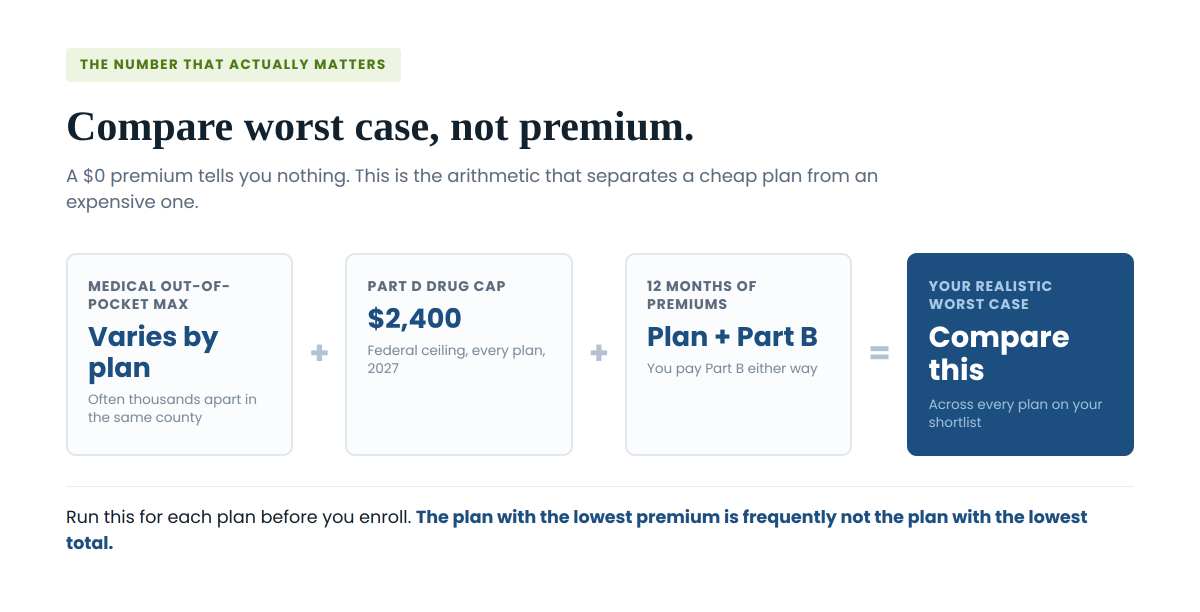
Run this on every plan on your shortlist: out-of-pocket maximum, plus $2,400, plus twelve months of premiums. That’s your worst case. The best plan is the one with the lowest worst case that still covers your doctors — almost never the one with the lowest premium.

Best 2027 Medicare Advantage Plans by Carrier

Carrier Best for 2026 data Where it can cost you
1. UnitedHealthcare Network size and nationwide availability ~26% market share · 78% of members in 4+ star plans Some counties get narrow HMO networks despite the national footprint
2. Humana Supplemental benefit breadth ~20% market share · broad national footprint Supplemental benefits are the first thing trimmed when margins compress
3. Aetna (CVS Health) Pharmacy integration and drug costs Top-five national · 81%+ of members in 4+ star plans Copays rise if your pharmacy isn’t in the preferred network
4. Kaiser Permanente Quality ratings, where available 100% of contracts rated 4+ stars Limited regions, and you must use Kaiser doctors and facilities
5. Blue Cross Blue Shield Regional networks and local provider depth Independent licensees · varies by state A strong Blue plan in one state says nothing about the next

1. UnitedHealthcare — best for network size and nationwide availability

UnitedHealth Group covered roughly 26% of all Medicare Advantage enrollees in 2026, the largest share of any carrier. For anyone judging “best,” the practical value is provider access: a deep network lowers the odds that the specialist you need next year falls outside it, and out-of-network care is where unplanned costs come from. In 2026, 78% of its members sat in plans rated 4 stars or higher.

Where it can cost you: that breadth is a national average, not a promise about your county. UnitedHealthcare sells narrow HMO products in some markets with tighter networks than the headline suggests. Check your own doctors against the exact plan number.

2. Humana — best for supplemental benefit breadth

Humana held roughly 20% of Medicare Advantage enrollment in 2026, meaning it and UnitedHealth Group together account for about 46% of the entire market. Humana has historically competed hardest on the extras — dental, vision, hearing, OTC allowances, and fitness programs — which is why it lands on most “best benefits” lists.

Where it can cost you: extras are the most volatile part of any Medicare Advantage plan and the first line item carriers cut when margins tighten. Reductions have been widely reported across recent plan years. Get every benefit you’re counting on confirmed for 2027 in writing.

3. Aetna (CVS Health) — best for pharmacy integration and drug costs

Aetna’s CVS ownership ties the plan directly to the pharmacy counter, and that matters more in 2027 than it did before — with the cap at $2,400 and the deductible at $700, formulary placement now drives a bigger share of your total. In 2026 more than 81% of Aetna’s Medicare Advantage members were in plans rated 4 stars or higher, the strongest figure among the large national carriers.

Where it can cost you: preferred pharmacy networks cut both ways. If your regular pharmacy isn’t preferred, your copays go up on every fill.

4. Kaiser Permanente — best for quality ratings, where available

Kaiser had 100% of its Medicare Advantage contracts rated 4 stars or higher for 2026 — the strongest quality profile of any carrier operating at scale. Because Kaiser is both the insurer and the provider system, cost and care coordination tend to be more consistent than in a contracted-network model.

Where it can cost you: availability. Kaiser operates in a limited set of regions, and you must use Kaiser facilities and physicians. If you’re committed to an outside doctor, no star rating makes this the right plan.

5. Blue Cross Blue Shield — best for regional networks and local provider depth

Blue Cross Blue Shield operates as independent licensees by state, so there’s no single national plan or rating to point at. In many markets the local Blue has the deepest relationships with regional hospital systems, which can deliver better in-network access than a national carrier manages in that same county.

Where it can cost you: variation between licensees is enormous. A strong Blue plan in one state tells you nothing about the one next door. Judge the specific state licensee, never the brand.

Find & Compare Plans Online

Speak with a licensed insurance agent

1-833-641-4938TTY 711

Mon-Fri: 8am-9pm ET

Best-Rated Plans: What Star Ratings Really Tell You

Star ratings aren’t only a quality score — they drive the bonus payments that fund supplemental benefits and low premiums. A plan whose rating slips has less money to spend on you the following year, which is why a “best rated” plan today can be a thinner plan tomorrow.

Two 2026 figures worth carrying into your 2027 decision:

  • The average MA-PD rating fell to 3.65 stars for 2026, down from 3.92. The industry moved down, not up.
  • Eighteen contracts earned 5 stars for 2026, up from seven the prior year — though they aren’t sold in every county.

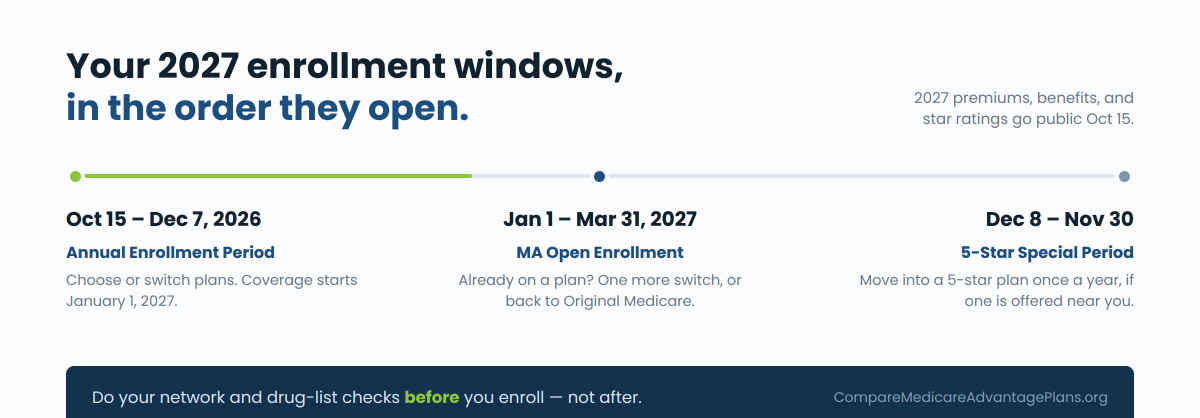
If a 5-star plan is offered where you live, it comes with a scheduling edge: the 5-Star Special Enrollment Period lets you switch into it once a year outside the standard windows, between December 8 and November 30.

What's Changing in Star Ratings for 2027

The CY 2027 final rule changed how ratings are calculated. What matters to you as a shopper:

  • Eleven measures were removed — administrative process measures where nearly every plan scored identically, so they weren’t separating good from bad.
  • The Excellent Health Outcomes for All reward was discontinued, while the historical reward for consistently high performance continues.
  • A new Part C depression screening and follow-up measure was added, phasing in for the 2029 Star Ratings.

Practical effect: 2027 ratings rest on a different measure set than prior years, so a plan’s 2027 stars aren’t a clean like-for-like against its rating from two years ago.

Supplemental Benefit Rules That Change in 2027

Three finalized changes affect the extras that “best benefits” lists love to highlight:

  • Plans must publicly post their eligibility criteria for Special Supplemental Benefits for the Chronically Ill. These were often opaque — now you can check whether you’d actually qualify before enrolling.
  • Benefit debit cards require real-time eligibility verification, which cuts down declined transactions but means the card checks eligibility at the register.
  • Mid-year unused-benefit notices are no longer required. Your plan doesn’t have to remind you about allowances you haven’t spent — track them yourself.

How to Pick the Best Plan for You: Five Checks

  • Your doctors. Confirm each physician and your preferred hospital participate in that specific plan for 2027 — not merely that they “accept Medicare.” Networks change every year.
  • Every prescription, by tier. Check each drug against the 2027 formulary, including tier and prior authorization. This decides how fast you hit the $2,400 cap.
  • The medical out-of-pocket maximum. Compare it across your shortlist. It’s what protects you in a serious health year.
  • Total annual cost. Premium plus expected copays plus drug spend — never the premium alone.
  • The extras you’d genuinely use. Not all plans offer all benefits, and availability varies by plan and service area. A benefit you’ll never use is worth nothing.

When You Can Enroll for 2027

Medicare Advantage plan enrollment windows 2027

The Annual Enrollment Period runs October 15 through December 7, 2026, for coverage effective January 1, 2027. That’s when 2027 plan details, premiums, and star ratings become public — and when any honest “best plans” comparison can finally name specifics.

If you’re already in a Medicare Advantage plan, the Medicare Advantage Open Enrollment Period from January 1 to March 31, 2027 gives you one more switch, or a route back to Original Medicare.

If you’re new to Medicare, your Initial Enrollment Period runs from three months before through three months after the month you turn 65.

Ready to see what’s available where you live? Compare 2027 Medicare Advantage plans by ZIP code.

Compare plans and enroll online

Best 2027 Medicare Advantage Plans — Frequently Asked Questions

  What are the best Medicare Advantage plans for 2027?

There’s no single best plan nationally, because Medicare Advantage is sold county by county. Among the major carriers, UnitedHealthcare leads on network size at roughly 26% market share, Humana on supplemental benefit breadth at roughly 20%, Aetna on pharmacy integration with 81%+ of members in 4-star-or-better plans, and Kaiser Permanente on quality with 100% of contracts at 4+ stars where it operates. The best plan for you is the one among those offered in your ZIP code that covers your doctors, carries your prescriptions at a low tier, and has the lowest out-of-pocket maximum.

  Which carrier has the best Medicare Advantage plans for 2027?

It depends what you’re optimizing for. UnitedHealthcare for provider access, Humana for extras, Aetna for drug costs, Kaiser for quality ratings in its regions, and the local Blue Cross licensee for regional hospital depth. Carrier strength is a national average — two plans from the same carrier in neighboring counties can differ substantially, so compare at the plan level, not the brand level.

  Are there any 5-star Medicare Advantage plans?

Yes. Eighteen Medicare Advantage contracts earned 5 stars for 2026, up from seven the prior year, though they aren’t offered in every county. Five-star plans also carry an enrollment advantage: the 5-Star Special Enrollment Period lets you switch into one once per year between December 8 and November 30, outside the standard windows. Check whether your doctors participate before assuming a 5-star plan is the best fit.

  What is the Medicare Part D out-of-pocket cap for 2027?

The 2027 annual out-of-pocket cap for prescription drugs is $2,400, up from $2,100 in 2026. Once you reach it, you pay nothing more for covered formulary drugs for the rest of the calendar year. The standard Part D deductible for 2027 is $700, up from $615 — though many of the better plans set a lower drug deductible or none at all.

  Is a $0 premium plan the best Medicare Advantage option?

Not automatically. A $0 premium plan can still carry copays, a drug deductible up to $700, and a higher medical out-of-pocket maximum than a plan charging a monthly premium. You’ll pay your Medicare Part B premium either way. Compare total expected annual cost — premium plus copays plus drug spend — rather than the premium line alone.

  Are Medicare Advantage benefits being cut in 2027?

Specific 2027 benefits aren’t public until the Annual Enrollment Period, so nothing is confirmed. Supplemental benefit reductions have been widely reported across recent plan years as carriers respond to margin pressure, so expect variation. Confirm every benefit you’re relying on in the plan’s official 2027 Summary of Benefits before enrolling rather than assuming it carries over from 2026.

  What is changing with Medicare Advantage star ratings in 2027?

CMS removed 11 administrative process measures where plan performance barely varied, discontinued the Excellent Health Outcomes for All reward, and added a Part C depression screening measure phasing in for the 2029 ratings. Because the measure set changed, a plan’s 2027 rating isn’t a direct like-for-like comparison against its rating from two years earlier.

  What is the out-of-pocket maximum on a Medicare Advantage plan?

Every Medicare Advantage plan caps your annual in-network medical spending — a structural advantage over Original Medicare, which has no cap. The amount varies substantially between plans, sometimes by several thousand dollars in the same county, which is why it’s the strongest single indicator of whether a plan deserves to be called best. It’s separate from the $2,400 prescription drug cap, so budget for both.

  Do I still have to pay the Part B premium with a Medicare Advantage plan?

Yes. Medicare Advantage changes how your Part A and Part B benefits are delivered, but you remain enrolled in Medicare and keep paying the Part B premium. Some plans offer a Part B giveback that reduces this amount, but that’s a specific plan feature and not a general rule.

  When can I enroll in a 2027 Medicare Advantage plan?

The Annual Enrollment Period runs October 15 through December 7, 2026, for coverage effective January 1, 2027. If you’re already in a Medicare Advantage plan, the Medicare Advantage Open Enrollment Period from January 1 to March 31, 2027 allows one additional switch. If you’re new to Medicare, your Initial Enrollment Period runs three months before through three months after your 65th birthday month.

Have Questions?

Speak with a licensed insurance agent

1-833-641-4938

TTY users 711

Mon-Fri: 8am-9pm ET

Find & Compare Plans Online

Speak with a licensed insurance agent

1-833-641-4938TTY 711

Mon-Fri: 8am-9pm ET

ZRN Health & Financial Services, LLC, a Texas limited liability company

( Medicare Expert )

Russell Noga is the CEO of ZRN Health & Financial Services, and head content editor of several Medicare insurance online publications. He has over 15 years of experience as a licensed Medicare insurance broker helping Medicare beneficiaries learn about Medicare, Medicare Advantage Plans, Medigap insurance, and Medicare Part D prescription drug plans.